Antibiotic Paste vs. Calcium Hydroxide for Immature Teeth
A July 2026 International Endodontic Journal meta-analysis compared the medicines used to disinfect immature, non-vital teeth before regenerative treatment. Triple antibiotic paste and calcium hydroxide performed almost identically — an endodontist explains what that means for young patients.
When an adult loses the nerve inside a tooth, the fix is a standard root canal. But when the same thing happens to a child or teenager whose tooth has not finished growing, the situation is very different. The root of an immature tooth is still short, and its walls are thin with a wide-open tip. A conventional root canal on that tooth is difficult and often leaves it fragile for life.
Regenerative endodontics offers a smarter path. Instead of simply filling the canal, the goal is to disinfect it, then encourage the body's own cells to continue building the root — thicker walls, a longer root, and a narrower tip. The single most important step in that process is disinfection: getting the canal clean without harming the fragile stem cells that make regeneration possible.
For years, clinicians have debated which medicine does that job best. A July 2026 systematic review and meta-analysis in the International Endodontic Journal (Alovisi and colleagues) pooled the available evidence to compare them head to head. The answer is reassuring — and a little surprising.
The three medicines being compared
Three intracanal medicaments are placed inside the canal for a few weeks between the first and second visit to disinfect it:
- Triple antibiotic paste (TAP) — a mix of three antibiotics (traditionally metronidazole, ciprofloxacin, and minocycline).
- Double antibiotic paste (DAP) — the same idea, minus minocycline (which can stain the tooth grey).
- Calcium hydroxide (CH) — a long-established, inexpensive antibacterial paste used across dentistry for decades.
The debate matters because each has trade-offs. Antibiotic pastes are powerful but can be harsh on the stem cells that regeneration depends on, and minocycline can discolor the tooth. Calcium hydroxide is gentle and cheap, but some worried it might not disinfect aggressively enough.
What the 2026 meta-analysis found
The review pooled clinical outcomes across multiple studies of immature, non-vital permanent teeth. The headline result: at one year, the success rates were remarkably close for the two leading options.
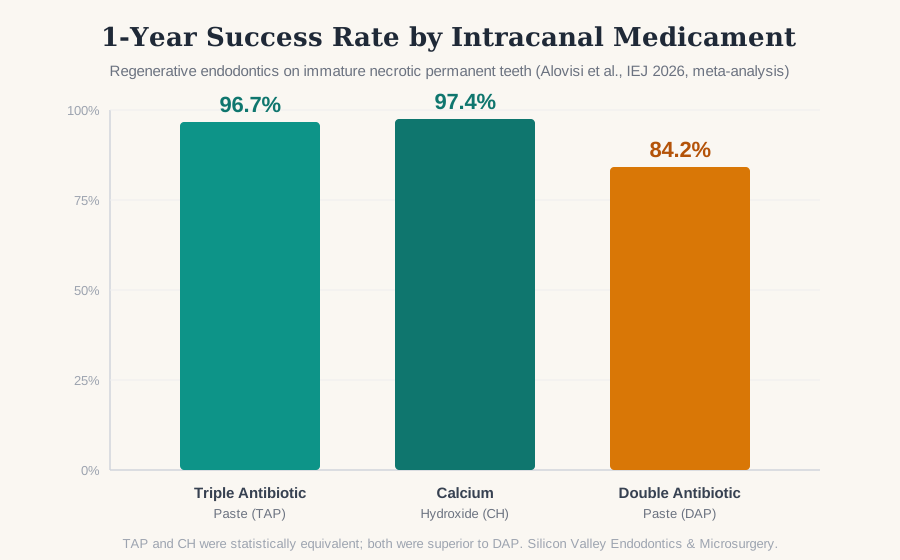
- Triple antibiotic paste: 96.7%
- Calcium hydroxide: 97.4%
- Double antibiotic paste: 84.2%
Statistically, TAP and CH were equivalent — there was no meaningful winner between them for clinical success. Both clearly outperformed the double antibiotic paste in this pooled analysis.
Why this is good news for young patients
The practical takeaway is powerful: calcium hydroxide — the gentle, inexpensive, decades-old option — held its own against the strongest antibiotic paste. That matters for three reasons:
- Tooth color. Calcium hydroxide does not cause the grey staining that minocycline in triple antibiotic paste can produce on a front tooth — a real concern for a teenager.
- Stem-cell safety. A less caustic medicine is easier on the very cells regeneration relies on to rebuild the root.
- Access and cost. Calcium hydroxide is universally available and cheap, which matters for families and for clinics worldwide.
None of this means antibiotic pastes are obsolete. In some infected cases a clinician may still prefer them, and every child's tooth is judged individually. But the evidence now supports calcium hydroxide as a first-line, tooth-friendly choice for many immature teeth — a conclusion families can feel good about.
One honest caveat
The authors used an indirect comparison and noted that the underlying studies vary in quality. "Success" here means the tooth stayed symptom-free and the infection resolved on X-ray at about one year; it does not guarantee identical root-thickening between medicines, which is harder to measure and where research continues. As always, a peer-reviewed meta-analysis sharpens the picture rather than closing the book.
What this means if your child needs treatment
If your child or teenager has a permanent tooth with a dead or dying nerve — often after a sports injury, deep decay, or trauma — ask whether the tooth is a candidate for regeneration rather than a full root canal or extraction. Preserving a natural tooth that can keep growing is almost always the best long-term outcome.
Dr. Jason Kung performs regenerative endodontic procedures under the surgical microscope at Silicon Valley Endodontics & Microsurgery. Learn more about regenerative endodontics and how immature teeth are saved, or contact our office to discuss your child's tooth.