Seniors Are Keeping Their Teeth Longer: New Data
New national claims data shows adults 65+ were the only age group with growing root canal utilization in 2024. Dr. Jason Kung explains why older Americans are keeping their teeth, what that means for heavily restored dentitions, and how age changes (and doesn't change) tooth-saving treatment.
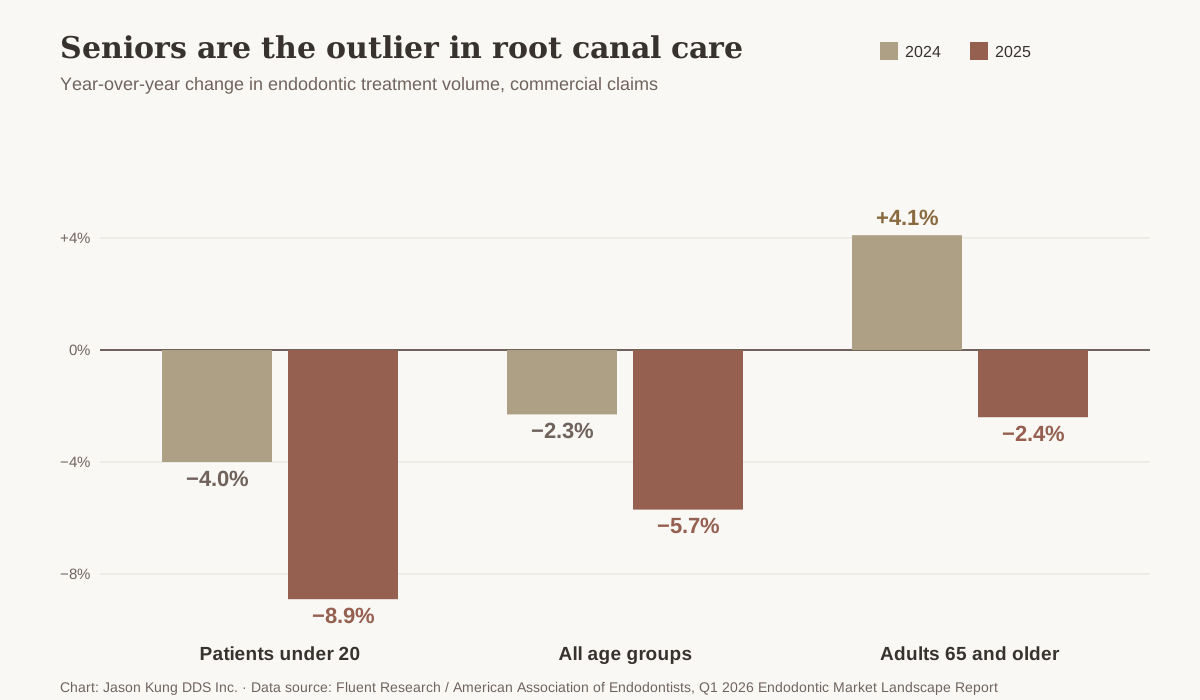
Every so often a statistic captures a generational change in a single line. The newest national analysis of dental insurance claims, prepared by Fluent Research and published by the American Association of Endodontists this month, contains one: in 2024, adults age 65 and older were the only age group whose endodontic treatment volume grew — up 4.1% while every younger bracket declined.1,2 Seniors' volume moderated to a modest −2.4% in 2025, far gentler than the market overall, and their share of all endodontic treatment climbed from 19% in 2023 to 21% in 2025. As an AAE member I have read the full three-year Fluent report behind the headline, and the age tables are the most striking pages in it: the steepest declines sit at the other end of the curve, with patients under 20 down 4.0% in 2024 and another 8.9% in 2025.2
The denture generation is gone
To appreciate how remarkable that is, consider what dental care for seniors meant within living memory. For Americans who came of age in the mid-20th century, losing most or all of your teeth by retirement was so common it was treated as normal aging. Complete dentures were a rite of passage.
That world has quietly disappeared. Fluoridated water, sealants, better restorative dentistry, and decades of prevention mean today's 70-year-old typically arrives at our office with most of her natural teeth — teeth that have been filled, crowned, and patched over fifty years. The Fluent researchers point to exactly this: Americans are retaining natural teeth longer and entering retirement with more heavily restored dentitions, which increases the need for tooth-preserving treatment later in life.1 A tooth that has carried a large filling since 1985 and a crown since 2005 has an aging nerve inside an increasingly brittle structure — and when that nerve finally fails, the choice is a root canal or losing a tooth that has served faithfully for decades.
Coverage is reinforcing biology. Many Medicare Advantage plans added meaningful dental benefits over the past decade, which the report credits as a likely contributor to rising utilization among older adults.1
One more detail from the full report underscores how broadly people are keeping their teeth: while treatment volume fell 2.3% in 2024, the number of patients receiving endodontic care actually rose 1.1% that year.2 More people getting tooth-saving treatment, slightly fewer procedures each — which is what you'd expect when care is sought earlier and teeth are healthier at every age.
Does a root canal work differently at 75?
The clinical answer is reassuring: age alone is almost never a barrier to root canal treatment, and success rates in healthy older adults are comparable to younger patients. What changes is the context around the tooth — and this is where treating seniors is genuinely a different craft:
- Canals narrow with age. The pulp space naturally calcifies over decades, which can make finding and negotiating the canals the hardest part of the procedure. This is precisely where a surgical microscope and CBCT 3D imaging earn their keep.
- Medications matter more than birthdays. Blood thinners, bisphosphonates, and immunosuppressants change how we plan treatment — usually in favor of saving the tooth, since root canal therapy avoids the surgical risks that extraction carries for these patients. We covered this in depth in our guide to root canals for seniors.
- The alternative is costlier at 75 than at 35. Extraction is never just extraction — it's a bridge, an implant, or a gap. For patients on bisphosphonates or with limited bone, implant surgery may be riskier than in younger patients, which makes preserving the natural tooth even more valuable.
The other end of the age curve
The same report shows the mirror image among the youngest patients: utilization for ages 0–19 is declining, and the researchers expect therapies that arrest early cavities before they reach the nerve to keep bending that curve.1 We recently wrote about the most prominent example — silver diamine fluoride, the liquid that stops cavities without drilling. Pulp capping, which treats a nearly exposed nerve without a full root canal, also grew its share of treatment in the analysis, from 11% to 12%.1
Put the two trends together and a picture of the future emerges: fewer root canals in young patients as prevention improves, and more tooth-saving care in older adults determined to keep their natural teeth for life. As an endodontist, that is a future worth welcoming on both ends.
Practical advice if you're 65+ (or caring for someone who is)
- Don't let age talk you out of saving a tooth. If someone frames extraction as the simpler choice for an older patient, ask what replaces the tooth — and what that costs and involves. Our root canal vs. extraction comparison walks through the trade-offs.
- Bring your full medication list to every dental visit. It changes planning more than any other single piece of information.
- Don't assume a quiet tooth is a healthy tooth. Older, calcified teeth often infect silently — no pain, just a shadow on an X-ray. Those infections still matter for whole-body health, especially for patients managing diabetes or heart disease.
- Use your benefits early in the year — or before they expire. The claims data shows root canal volume peaking every Q1 as annual benefits renew, and average fees climbing 3–7% per year.2 A tooth that needs attention is cheaper to treat this year than next.
- Check your Medicare Advantage dental benefits. Many plans now include meaningful endodontic coverage — the national data suggests seniors are increasingly using it. Our insurance page explains how we verify benefits before treatment.
The bottom line
The national numbers confirm what we see in our Sunnyvale operatory every week: the fastest-growing group of root canal patients is retirees who have kept their teeth for seventy years and intend to keep them for twenty more. That is not a burden on the system — it is one of modern dentistry's clearest success stories, and tooth-saving care is how it continues.