Root Canal Too Complex for a General Dentist? 2026 Study
How do dentists decide whether a root canal is straightforward or needs a specialist? A 2026 International Endodontic Journal review examined the tools that grade case difficulty. An endodontist explains what makes a tooth 'complex' — and when referral protects your tooth.
If you need a root canal, you may wonder: should my regular dentist do this, or should I see a specialist? It's a fair question — and it turns out the profession has been asking a more formal version of it for years. Dentists use structured case-difficulty assessment tools to grade how hard a given root canal is likely to be before anyone picks up an instrument.
A 2026 scoping review in the International Endodontic Journal (Lin and colleagues) systematically examined these tools — how they work, what they measure, and how well they hold up. For patients, it's a rare look behind the curtain at how the decision to treat or refer actually gets made.
Why case difficulty matters
A root canal on a simple front tooth with one straight canal is a very different procedure from a root canal on a back molar with four curved, calcified canals — or a retreatment of a root canal that already failed. The gap in difficulty is enormous, and outcomes suffer when a complex case is under-resourced. Grading difficulty up front helps a dentist answer three questions honestly:
- Do I have the training for this specific tooth?
- Do I have the equipment — magnification, 3D imaging, the right instruments?
- Is the patient better served by a referral to an endodontist?
What the difficulty tools measure
The review found that the most established framework is the American Association of Endodontists (AAE) Case Difficulty Assessment, alongside newer tools and apps. Despite different formats, they weigh a consistent set of factors, which generally sort teeth into three tiers.
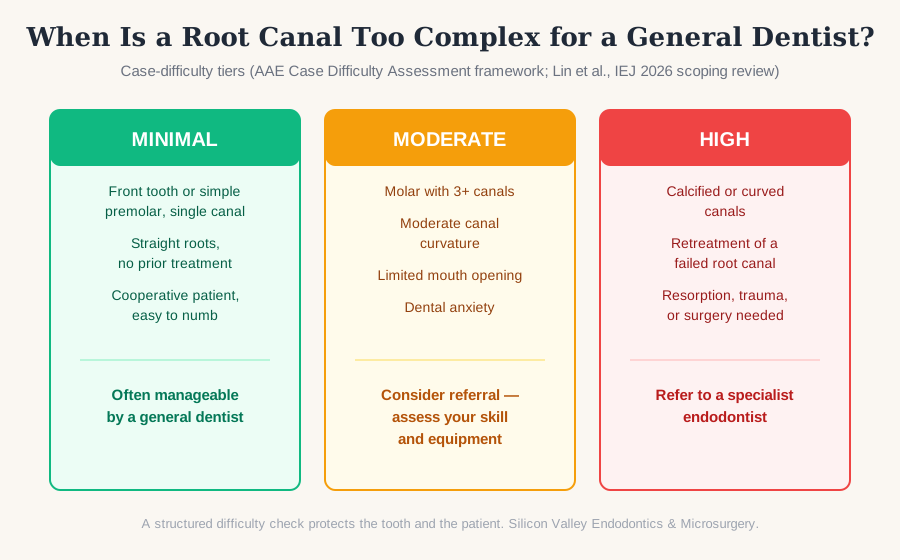
The factors that push a case toward "complex" include:
- Tooth position and anatomy — molars with multiple canals are harder than single-canal front teeth.
- Canal shape — curved, S-shaped, or narrow, calcified canals are much more demanding.
- Prior treatment — retreating a failed root canal is inherently more difficult than a first-time procedure.
- Special situations — resorption, dental trauma, or a need for surgery.
- Patient factors — limited mouth opening, complex medical history, or significant dental anxiety.
What the 2026 review concluded about the tools themselves
Importantly, the review was honest about limitations. While these tools are valuable for structuring the decision, the science behind them is still maturing:
- Different tools don't always agree on the same tooth, and few have been rigorously validated against real-world outcomes.
- Most rely on the clinician's judgment to score each factor, so results can vary between practitioners.
- The authors called for better-standardized, outcome-validated tools going forward.
In other words, difficulty assessment is a structured aid to judgment, not a rigid formula. But even an imperfect checklist is far better than no checklist — it prompts an honest conversation before treatment begins.
What this means for you as a patient
You don't need to memorize a scoring system. The takeaway is simpler: complex teeth benefit from specialist care. An endodontist is a dentist who completed 2–3 additional years of training focused solely on root canals, works under a surgical microscope, and uses 3D CBCT imaging — exactly the resources that difficult cases demand.
It's completely reasonable to ask your dentist: "How would you rate this tooth's difficulty, and would I be better off seeing a specialist?" A good dentist will welcome the question. Referring a hard case isn't a shortcoming — it's the difficulty assessment working exactly as intended, to protect your tooth.
Dr. Jason Kung is a board-eligible specialist endodontist who treats the complex cases general dentists refer. Learn more about the difference between an endodontist and a general dentist, or contact our office if you or your dentist think your tooth needs specialist care.