Who Performs Root Canal Retreatment? 82% Are Endodontists
New U.S. insurance-claims data: endodontists perform 82% of root canal retreatments — and retreatment was the most stable endodontic procedure of 2024–2025. What that means if your root canal failed.
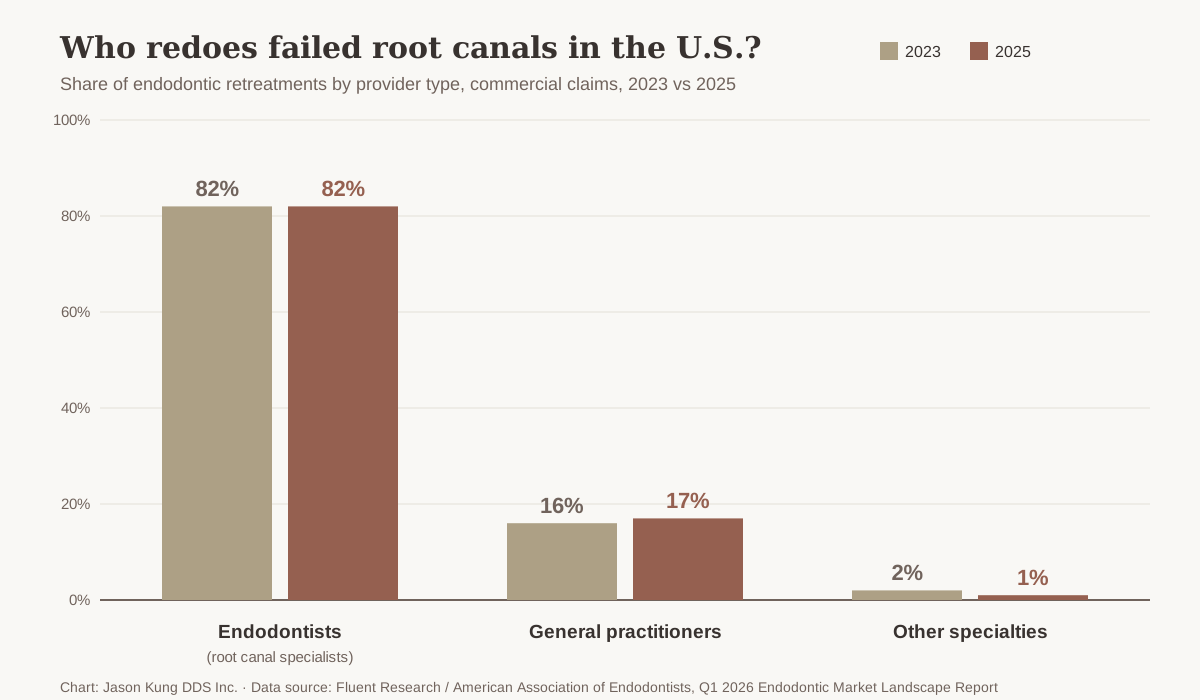
If your root canal fails, who should redo it? You could ask ten dentists — or you could look at what actually happens across the entire commercially insured population of the United States. The Q1 2026 Fluent Research market analysis, published by the American Association of Endodontists, answers the question with unusual clarity: endodontists perform 82% of all root canal retreatments. General practitioners perform 17%. Every other specialty combined performs about 1%.1,2
Why this number matters more than the headline share
I wrote recently about the broader trend in the same dataset — specialists' share of all endodontic procedures climbing from 43% to 45%. But the overall share blends easy cases with hard ones. Retreatment is where the blending stops: it is the single procedure category where the referral system votes most decisively, and it votes 82–17.
Remember who is making these decisions. Any licensed dentist may legally retreat a root canal. The 17% that general practices keep are presumably the cases they judged straightforward. For everything else, the dentist who saw the failed root canal — often the person who did the original treatment — chose to send it to a specialist. When the professionals closest to the problem route five out of six cases out of their own chairs, that is not marketing. That is informed people acting on what they know about the procedure's difficulty.
The share holds across every tooth type
You might expect specialists to dominate only the hard molars. They do dominate there — 85% of molar retreatments — but the pattern barely softens at the front of the mouth: endodontists perform 75% of anterior retreatments and 78% of premolar retreatments.2 Compare that with first-time root canal therapy, where general practices still handle about two-thirds of anterior teeth. The moment a tooth becomes a re-treatment, even the easy tooth types migrate to specialists.
The reason is what retreatment actually involves. Before any disinfection can start, the existing crown or filling, any posts, and all of the old filling material must come out without damaging the remaining root — then the clinician has to find whatever the first treatment missed: an extra canal, a ledge, a blocked apex. That detective work is why root canals fail in the first place, and it is microscope-and-CBCT territory. Our own protocol for these cases is described on the retreatment service page.
The quietest procedure in a shrinking market
The same report documents a market in decline: total endodontic treatment volume in the insured population fell 2.3% in 2024 and 5.7% in 2025. Against that backdrop, retreatment barely moved — down just 1.8% and then 1.4%, the smallest declines of any major endodontic subcategory.2
That stability makes sense once you think about what drives each procedure. First-time root canals compete with extraction-and-implant decisions, insurance coverage cycles, and patients postponing care. Retreatment demand is different: it is generated by the existing stock of millions of previously treated teeth, a small percentage of which develop problems each year regardless of the economy. Failed root canals do not wait for open enrollment.
What the odds look like when a retreatment is done well
The market data tells you who does retreatments; the clinical literature tells you how they turn out. A 2024 systematic review of 29 studies put nonsurgical retreatment success at 78.0–86.4%, with periapical healing in 78.8–87.5% of cases, depending on the criteria used. Those are strong odds for a tooth that has already failed once — but they are also the reason case selection and technique matter so much. The margin for error is thinner the second time: whatever anatomy defeated the first clinician is still in the tooth, waiting.
If you are weighing options for a failed root canal, start with the honest framework in our guide to root canal failure and retreatment, and for teeth where nonsurgical retreatment is not the right tool, see how retreatment compares with apicoectomy and extraction.
The bottom line
Numbers this lopsided are rare in healthcare. When 82% of a procedure flows to 4% of the profession — steadily, for three years, across every tooth type — the market has already answered the question patients ask us every week. If your root canal has failed, the system that dentists themselves use routes that tooth to an endodontist. It is worth understanding why before deciding who opens your tooth a second time.