Why More Root Canals Go to Specialists: New Data
A new Fluent Research analysis published by the American Association of Endodontists shows the share of root canals performed by specialist endodontists climbing from 43% to 45% in just two years. Dr. Jason Kung on what's driving the shift and what it means for patients and referring dentists.
Twice a year, the American Association of Endodontists publishes an analysis of national insurance-claims data prepared by Fluent Research — essentially a census of how root canal care is actually being delivered across the United States. The newest edition, covering three full years of claims through December 2025, landed this month, and as an AAE member I have read the full report, not just the headlines.1,2 Most of it is written for practice owners, but several findings matter directly to patients and to the general dentists who refer to us.
Finding one: the specialist share keeps climbing
In 2023, specialist endodontists performed 43% of the endodontic procedures in the commercially insured population Fluent analyzed. By 2025 that figure had reached 45%, while the share performed by general practitioners slipped from 46% to 45% and other specialties declined from 11% to 10%.1 For the first time in this dataset, endodontists are performing as large a share of root canal treatment as general dentists.
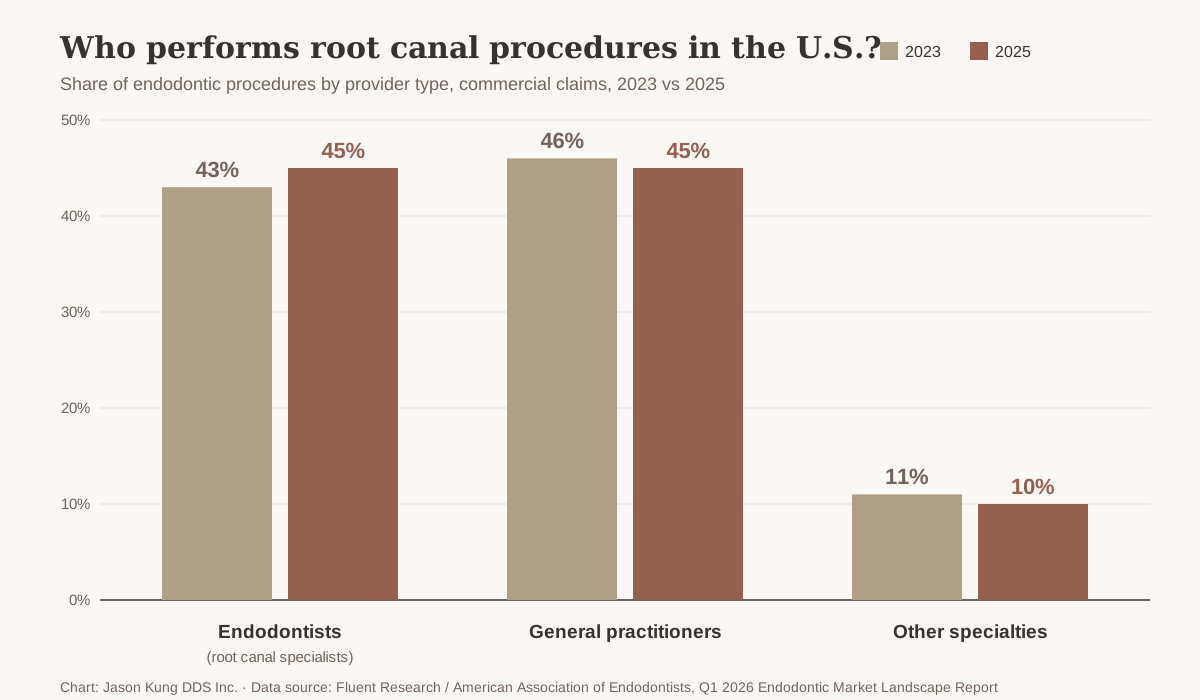
Two percentage points may sound small, but the direction is what matters — and the volume numbers underneath make the story clearer. Overall endodontic treatment volume in the insured population declined 2.3% in 2024 and 5.7% in 2025. Specialist volume barely moved: down 0.7% and 2.0%, compared with drops of 2.5% and 7.0% among general practitioners and 6.5% and 13.7% among other specialties.2 When demand softens, the cases that remain are disproportionately the complex ones — and those keep flowing to specialists.
The subcategory tables in the full report make the sorting even more visible. The harder the procedure, the more completely it already belongs to specialists: endodontists perform roughly 82% of root canal retreatments and 75–77% of apicoectomies (surgical root-end treatment), versus about half of first-time root canal therapy — and within therapy, their share rises with difficulty, from roughly a third of front teeth to about 60% of molars.2 Those shares grew or held across the board between 2023 and 2025, with the clearest gains in retreatment and apicoectomy.
Why complex cases migrate to specialists
None of this means general dentists shouldn't do root canals. Many are excellent at them, and straightforward anterior cases are well within a general practice's comfort zone. What the data reflects is a sorting process that has been underway for years:
- Anatomy that hides from 2D X-rays. Curved canals, extra canals (the infamous MB2 in upper molars), and calcified canals are hard to find without a CBCT scan and an operating microscope.
- Retreatments and complications. Redoing a failed root canal, removing a separated instrument, or repairing a perforation are specialist territory almost by definition.
- Diagnostic ambiguity. When it isn't clear which tooth hurts — or whether the problem is a crack rather than an infection — a wrong guess is expensive. Specialists spend a large share of their time on exactly this question.
Finding two: 3D imaging is growing double digits
The companion analysis of diagnostic procedure codes found that CBCT with interpretation (code D0364) was the fastest-growing service in the entire dataset — up 13.4% in 2024 and another 11.0% in 2025, with growth across every provider type and age group.2
That growth is not a fad. A limited-field CBCT scan shows root anatomy, cracks, resorption, and bone changes that simply do not appear on a flat X-ray — we walked through real examples in our post on how CBCT changes endodontic diagnosis. The market data confirms what we see clinically: 3D imaging is becoming the standard of care for difficult diagnoses, not a luxury.
What this means if you're a patient
If your dentist suggests seeing an endodontist for your root canal, the national data should be reassuring rather than alarming: you are part of a system that increasingly routes harder cases to the people best equipped for them. A specialist referral usually means one of the complexity factors above applies to your tooth — not that anything has gone wrong.
And if you're weighing whether specialist care is worth it, the practical differences are concrete: microscope magnification, CBCT imaging, and a caseload made up entirely of procedures like yours. Those are the exact capabilities the market data shows patients and dentists selecting for.
What this means if you're a referring dentist
The volume numbers carry a quieter message for general practices: as overall claims volume declines, holding onto borderline endodontic cases is getting riskier, not safer. The cases most likely to remain in the shrinking pool are the complex ones — and the national pattern suggests your colleagues are referring them out. Our referring-doctor page covers our case-acceptance philosophy, imaging protocol, and report turnaround; the short version is that we handle the case and send the patient back.
The California picture
The state-level tables are sobering reading for anyone practicing here. California is one of the largest endodontic markets in the country, and its insured treatment volume declined 8.2% in 2024 — one of only two major states to shrink that year — and declined again in 2025 along with all eight of the largest states.2 Every decline in insured volume raises the same local question: how many Bay Area patients are postponing a tooth infection they should be treating? A root canal deferred is rarely a root canal avoided — it usually resurfaces as an emergency, when options are narrower and costs are higher.
Two practical footnotes from the fine print
- Fees are rising 3–7% a year. Average submitted charges per endodontic procedure grew roughly 3–7% annually in both 2024 and 2025, in-network and out — with Q4 2025 the most expensive quarter of the entire study period.2 Whatever a needed root canal costs today, the national trend says it will cost more next year. Our cost calculator can give you a realistic estimate now.
- Root canal volume peaks in Q1, every year. The seasonal pattern is unmistakable: treatment surges in January–March when annual insurance benefits renew, then tapers all year.2 If you are reading this in the fall with an aching tooth and unused benefits, waiting for January is the most expensive form of procrastination — you risk an emergency now and join the busiest queue later.
One caveat worth stating
Fluent's analysis is built on commercial insurance claims, so it cannot see care delivered outside that system — cash-pay treatment, public coverage, or procedures in uninsured populations. The authors are careful to say the decline in claims volume partly reflects shrinking commercial enrollment, not just treatment decisions.1 The specialist-share trend, however, is a within-dataset comparison and stands on firmer ground.
The bottom line
The organization of root canal care in America is quietly consolidating around a sensible principle: routine cases stay in general practices, and complex ones go to specialists with microscopes and 3D imaging. If your tooth turns out to be one of the complex ones, that system is working in your favor.