
Root Canal Treatment:
What to Expect
Root canals have a bad reputation — but the procedure itself is typically no more uncomfortable than getting a filling. This guide walks through exactly what happens, what it costs, and what recovery looks like.
Patient Education
Root canals, in 30 seconds to 3 minutes
Four short videos from the American Association of Endodontists — answering the questions patients most commonly ask before scheduling treatment.
When Is a Root Canal Necessary?
A root canal becomes necessary when the soft tissue inside your tooth (the pulp, containing nerves and blood vessels) becomes infected or severely inflamed. Left untreated, the infection spreads into the bone and surrounding teeth.
What's actually inside your tooth
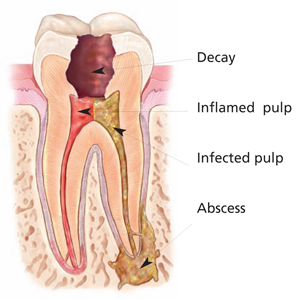
The hard outer enamel and the slightly softer dentin beneath it protect the pulp — the living core of nerves and blood vessels that runs from the crown of the tooth down through each root canal to the apex at the root tip.
When deep decay, a crack, or repeated dental work lets bacteria reach the pulp, the tissue becomes inflamed or infected. That's when you feel pain, sensitivity, or pressure. A root canal removes the infected tissue, cleans the entire canal system, and seals it — saving the tooth's outer structure so it can keep doing its job for decades.
Common signs you might need treatment
Persistent toothache, especially throbbing pain
Lingering sensitivity to heat long after the stimulus is gone
Severe sensitivity when biting or chewing
Darkening or discoloration of the tooth
Swelling or tenderness in the surrounding gum
A pimple-like bump on the gum (sinus tract / abscess)
Pain that wakes you up at night
Tooth pain following a deep cavity, crown, or filling
Sometimes a tooth that needs a root canal has no symptoms at all — it can be discovered on a routine X-ray. Only a thorough clinical exam can confirm whether treatment is needed.
The Procedure, Step by Step
Most root canals are completed in a single 60–90 minute appointment.
Diagnose
X-ray + CBCT 3D scan to map the canals before any work begins.
Numb
Profound local anesthesia. Nitrous oxide or oral sedation if you're anxious.
Clean
Remove infected pulp under the surgical microscope. Shape and disinfect every canal.
Seal
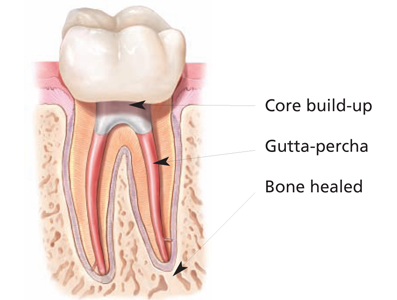
Fill the canals with biocompatible gutta-percha. Your dentist places a crown within 4–6 weeks.
In more detail
The four steps above expand into the six clinical steps Dr. Kung walks through with every patient.
Diagnosis & X-ray
Dr. Kung examines your tooth, takes digital X-rays, and often a CBCT 3D scan to map the root anatomy and confirm the diagnosis. This usually takes 20–30 minutes.
Local Anesthesia
The area is numbed thoroughly before any work begins. Most patients are surprised by how comfortable this is — modern anesthesia makes root canals far less painful than their reputation suggests. We confirm full numbness with a cold test before starting; if you're not fully numb, we wait or supplement.
Read: Will my root canal hurt? — A specialist's honest answerPulp Removal
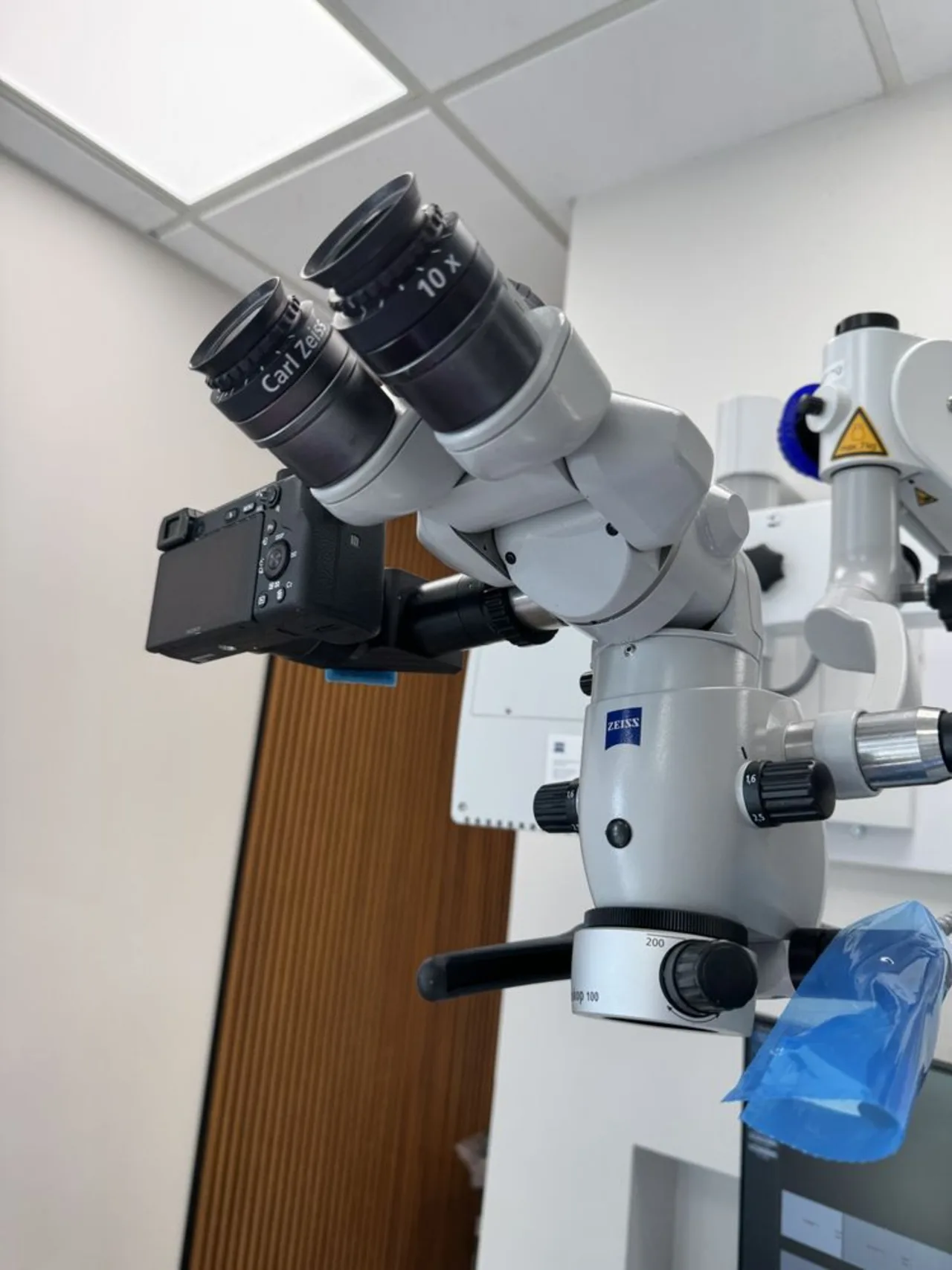
Under the Zeiss OPMI operating microscope, Dr. Kung accesses the inner pulp chamber, removes the infected or inflamed tissue, and cleans each canal to its full length.
Shaping & Disinfection
The canals are shaped with precision files and irrigated with antimicrobial solution to eliminate bacteria. This step is where specialist microscope use makes the biggest difference in outcome.
Sealing
The cleaned canals are filled with a biocompatible material called gutta-percha and sealed. A temporary or permanent filling is placed on top.
Crown (by your dentist)
Within 4–6 weeks, you'll return to your regular dentist for a crown to protect and restore the tooth. Dr. Kung sends a full treatment report so your dentist is fully informed.
Over 95%
Reported success rate for endodontic treatment in published clinical literature.
51%
Of endodontic therapy now performed by specialist endodontists — crossing the majority for the first time in 2025.
2–3 yrs
Of additional specialty residency endodontists complete beyond dental school.
Sources: AAE; Fluent Research / AAE Endodontic Market Landscape, Q1 2026.
Why specialists now perform the majority of root canals — read the full analysis
Recovery & What to Expect
During the procedure
You'll be fully numb. Many patients describe the experience as similar to a filling — pressure and vibration, but no sharp pain. A small number of patients with severe infections need a second dose of anesthetic; Dr. Kung is patient and will ensure you're fully comfortable before proceeding.
Immediately after
The area will be numb for a few hours. Some patients return to work the same afternoon. Avoid chewing on the treated tooth until your permanent crown is placed.
Days 1–3
Mild soreness is common as the tissue settles. Over-the-counter ibuprofen (Advil) handles this well for most patients. About 85% of patients report feeling better than before the procedure within 24 hours.
Long-term
A root canal-treated tooth with a proper crown can last a lifetime. The key is getting your crown placed promptly (within 4–6 weeks) — an unrestored treated tooth is vulnerable to fracture.
Root Canal or Extraction — Which Is Better?
When given the choice, saving your natural tooth is almost always the better option. Extractions may seem simpler or cheaper upfront, but replacing a missing tooth with an implant or bridge typically costs more and takes longer than a root canal plus crown.
Root Canal + Crown
- Saves your natural tooth
- Preserves jaw bone
- No gap in your smile
- Typically one to two appointments
- Crown may last decades with proper care
Extraction + Implant
- Removes the problem tooth entirely
- Implant required to fill the gap
- Higher total cost in most cases
- Multiple appointments over months
- Bone graft sometimes required
| Factor | Root Canal + Crown | Extraction + Implant |
|---|---|---|
| Total time to completion | 1–2 visits over 1–3 weeks (crown placed at the general dentist after). | 3–9 months — extraction, bone graft healing, implant placement, osseointegration, then crown. |
| Typical out-of-pocket (Sunnyvale, 2026) | $1,400–$2,400 (root canal) + $1,200–$1,800 (crown) ≈ $2,600–$4,200. | $4,500–$7,500 (implant + abutment + crown), plus $400–$1,500 if a bone graft is needed. |
| Long-term success (10+ years) | ~90% retention; well-restored teeth routinely last decades. | ~93–95% survival, but peri-implantitis and bone loss are not always counted as "failure." |
| Preserves natural tooth? | Yes — your natural root, ligament, and proprioception remain. | No — natural tooth is removed; some bone resorption is unavoidable. |
| Recovery | Mild soreness 2–4 days; most patients return to work the same day. | 3–7 days after extraction; additional recovery after implant surgery. |
| Bite feel | Identical to a natural tooth — periodontal ligament still senses pressure. | Slightly different — implants are ankylosed to bone, no ligament feedback. |
| When it's the better choice | Restorable tooth structure, no vertical root fracture, adequate periodontal support. | Tooth is non-restorable, vertically fractured, or has severe periodontal bone loss. |
Cost ranges reflect typical Bay Area fees as of 2026. Insurance reimbursement varies — request a written pre-treatment estimate before scheduling.
Frequently Asked Questions
How much does a root canal cost?
Cost varies by tooth and number of canals — front teeth (1 canal) are less than molars (3–4 canals). With PPO insurance, out-of-pocket cost is often $200–$600. Without insurance, treatment typically ranges from $900–$1,500. We provide a full estimate before starting and will verify your insurance benefits.
How long does a root canal take?
Most root canals are completed in 60–90 minutes in a single visit. Complex cases or retreatments may require a second appointment.
Can I drive myself home afterward?
Yes — root canals are done under local anesthesia only, not general sedation. You'll be numb for a few hours but can drive, work, and go about your day.
Why go to a specialist instead of my regular dentist?
Endodontists complete two additional years of specialty training exclusively focused on root canals and dental pulp. Dr. Kung also uses the Zeiss OPMI surgical microscope — most general dentists don't have one. For complex cases (calcified canals, curved roots, retreatments), specialist care significantly improves outcomes.
What if the root canal fails?
The success rate for root canal treatment is around 85–97%. If a treated tooth develops problems later, retreatment or endodontic surgery (apicoectomy) can often save it. Dr. Kung handles both retreatment and microsurgery.
Our Sunnyvale office
Where you'll be treated
Calm, modern, and built around the equipment that lets us see what general dentists usually can't — the Carl Zeiss surgical microscope and the J. Morita CBCT 3D scanner.



Further reading
- · Harvard Health — Need a root canal? Here's what to expect (English-language article; opens in a new tab)
- · Research & Evidence — the studies behind our protocols
- · Clinical Protocols & Case Evidence — for dental students and referring doctors
- · Why the microscope makes the difference
- · Why magnification matters most for molars
- · How long does a root canal last? Long-term outcomes
- · Save the tooth or get an implant — the long-term evidence
- · Can a calcified root canal still be treated? — how specialists assess narrow canals and treatment options.
Safety & common concerns
Read the evidence, then decide for yourself.
- · Is root canal treatment safe? — AAE, ADA, and WHO consensus plus the 2025 metabolomics research.
- · Root canal myths and facts — sourced answers to the most common patient misconceptions.
- · What the Netflix documentary got wrong — an 8-minute review of Root Cause and the science behind it.
Based on the research
94% success when surgical retreatment is needed.
Setzer FC et al., Journal of Endodontics 2010 — meta-analysis of 21 studies, 1,600+ cases.
When a non-surgical root canal isn't enough, modern endodontic microsurgery succeeds in 94% of cases — versus 59% with the older techniques still common in oral surgery offices. The protocols on this page are built around that evidence.
See the researchThe evidence behind root canal treatment
- The biological purpose of a root canal is to remove the bacteria that drive apical periodontitis — classic germ-free animal work showed that exposed pulps do not develop periapical disease without bacterial contamination.[1]
- Long-term outcome studies show that thorough bacterial control before sealing is the single strongest predictor of healing — canals rendered free of culturable bacteria healed at roughly 94% versus markedly lower when bacteria persisted.[2]
- Each step on this page — isolation, disinfection, shaping, and obturation — follows the standard of care set out in the AAE Guide to Clinical Endodontics.[3]
Root canal treatment — serving 30+ Bay Area cities
Dr. Jason Kung provides root canal treatment to patients across Silicon Valley from our Sunnyvale office. Evening and weekend hours, same-day emergencies, free on-site parking.
Questions? We're Happy to Help.
Call us or send a message — we'll answer your questions and get you scheduled, often same week.
Mon–Fri 8am–7pm · Sat–Sun 8am–3pm
Related on this site
- Watch: Does a root canal hurt?A 60-second explainer on why modern root canal treatment is essentially painless.
- Will my root canal hurt?Modern anesthesia techniques and what 97% of patients actually report.
- After your root canalRecovery timeline and red flags for the first 48 hours.
- Root canal cost in SunnyvaleSpecialist pricing, PPO coverage, and what you actually pay.
- How we disinfect canalsEvidence-based comparison of GentleWave, ultrasonic, laser, and traditional irrigation.
- Root canal myths and factsSourced answers to the most common misconceptions.
Related Articles
Treatment
Single- vs. Multiple-Visit Root Canals: 2026 Survey
A full 2026 Journal of Endodontics paper reports how U.S. endodontists say they choose one-visit or multiple-visit treatment. Here is what the survey estimates mean—and what they cannot tell you about your individual tooth.
ReadTreatment
Can a Cracked Tooth Be Saved? 263-Tooth Study
A cracked molar doesn't automatically mean extraction. A 2026 study of 263 cracked teeth found an overall success rate of 82.9% — with prognosis driven by how deep the crack runs and whether a gum pocket has formed along it.
ReadEmergency
Dental Abscess: Why It's a True Emergency
A dental abscess is more than a bad toothache — it's a bacterial infection that can spread beyond your jaw and become dangerous within hours. Knowing which warning signs separate “call the endodontist today” from “go to the ER now” matters enormously.
Read